
Embedded AI as a Service Technician
Costly downtime and service tickets are among the central challenges of running an efficient manufacturing operation. Embedded AI can help cut those costs and improve Overall Equipment Effectiveness (OEE) — by combining small and large language models with agentic AI to enable a “virtual service technician.” Together with our partner Grossenbacher Systeme, we have shown that this concept is already technically feasible today.
Every plant with automated production knows the problem: machines fail at times when no service technician is available — especially at night and on weekends. On top of that come performance and quality issues that even experienced operators cannot resolve on their own. Both cause considerable cost and trigger expensive service tickets. The question is whether embedded AI can put operators in a position to react to stoppages immediately and fix performance losses themselves, without a ticket.
Already available as a demonstrator
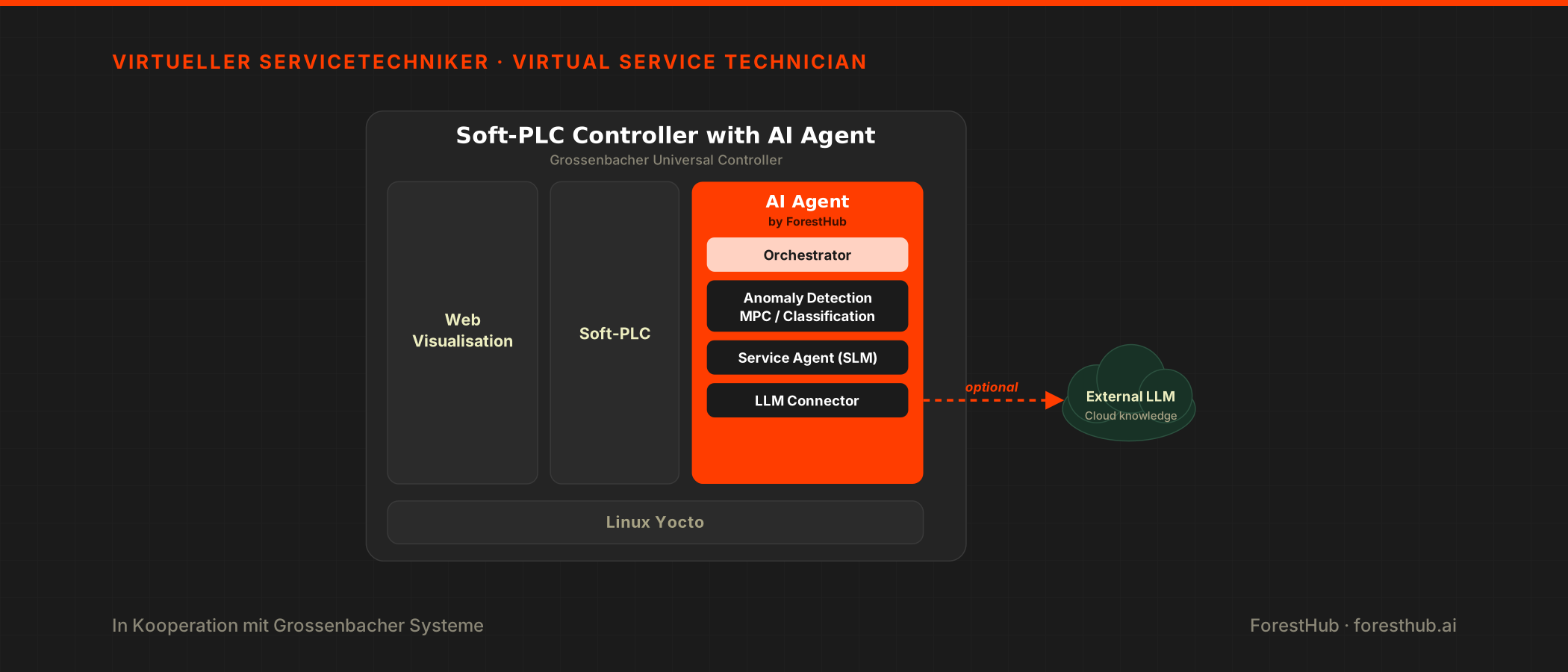
To prove the point, Grossenbacher Systeme built a demonstrator for an AI-based “virtual service technician” on top of its Universal Controller, using ForestHub’s AI agents. It maps a complete PLC and is supported by an AI agent that coordinates various tools and AI models depending on the situation and task — steering them deliberately and in context toward a defined goal. The interplay between the AI agent and a small language model (SLM) was the focus of the collaboration.
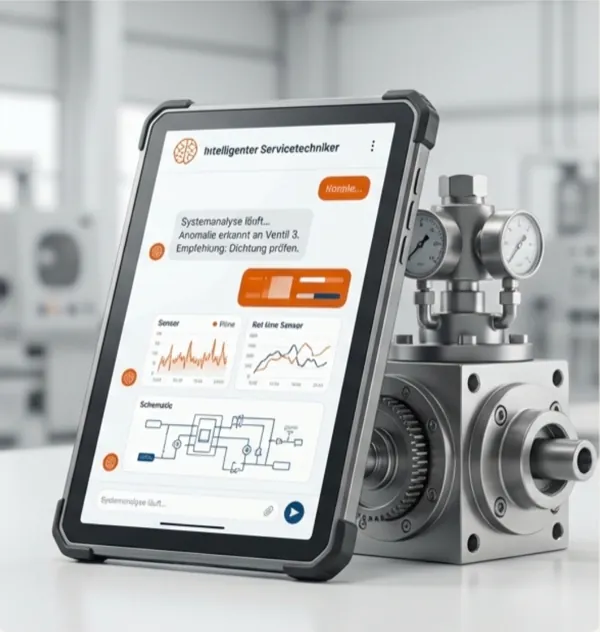
In the demonstrator, the virtual service technician looks after a printer. The concepts involved, however, are fundamentally suited to most machines and systems controlled by conventional PLCs. The AI agent first categorizes and classifies the data from the plant’s sensors in order to detect and report anomalies. A classical AI model handles this directly at the edge, inside the controller.
Its ability to run AI models locally also makes it possible to augment or replace the PID controller with AI-based model predictive control (MPC), provided the cycle time is above 50 ms. Instead of merely compensating for errors after the fact, an MPC — a control strategy for dynamic systems — also factors in future states, which supports the early and reliable detection of anomalies.
Models and agents as the foundation
To give the virtual service technician the knowledge base it needs, a small language model (SLM) comes into play. Unlike large language models (LLMs) trained generically on “world knowledge,” an SLM is trained only on domain knowledge about the specific machine or plant. That limits its resource footprint and enables local use on edge devices such as the Universal Controller.
The advantage: regardless of their size, language models are strong at logical reasoning, analyzing relationships, and interpreting numerous input variables in combination with defined output variables — including predictive elements. Using the SLM, the AI agent can assess the state of the machine and support the operator predictively: if a machine parameter points to a possible stoppage, the agent provides early guidance on checking the relevant environmental variables. If a stoppage occurs anyway, it supports the operator through logical reasoning and stored domain knowledge.
The AI agent and its SLM can also act as a “point of contact” between machine and operator, assisting as a virtual service technician — with explanations as text, images, and, where needed, audiovisual support. Decision-making authority remains with the operator; the human service technician stays relevant but will likely be needed less often.
What is critical stays local
The virtual service technician operates exclusively locally — with no connection to the internet, cloud services, or external servers. External systems come into play only when an external large language model (LLM) is optionally added as supplementary support. Hardened LLM instances at the site or company level are particularly suitable here, providing additional context — such as operating data from other machines or anonymized data from other users.
This architecture lets the classical real-time functions stay at the field level. The PLC operates according to IEC 61131-3 and guarantees deterministic behavior in the millisecond range — for safety functions or interlocks, for example. The non-deterministic AI components based on agents and SLMs are decoupled from this and live in their own containers at the edge-computing layer. On the hardware side, the Universal Controller with its ARM CPU and integrated NPU and GPU units forms the basis; the integrated Linux Yocto operating system supports OCI specifications for containerization.
This is exactly where ForestHub comes in: the orchestration of the AI components follows a graph-first approach. The flow — read a sensor, classify, assess, explain, escalate — is an explicitly wired graph in which the language model is one node among many, not the runtime itself. As a result, every decision the agent makes stays inspectable, replayable, and bounded to a finite action set — a prerequisite for making AI usable at all in a regulated manufacturing environment.
Conclusion: augmentation, not substitution
Just as plant availability is never fully reached and service costs never entirely disappear, AI will not completely replace human service technicians. The combination of PLC and AI can, however, noticeably relieve and support them — especially in manufacturing environments with few machines or outside regular service hours, it can improve OEE. AI-based “virtual service technicians” can already be implemented economically with current hardware and software, as the joint demonstrator by Grossenbacher Systeme and ForestHub shows.
Augmentation, not substitution — AI as relief, not replacement.
The technical article by Oliver Roth, CEO of Grossenbacher Systeme, appeared in the trade magazine “Computer & Automation” (issue 05-26). We provide the full article here as a PDF:
Read the article: Embedded AI as a Service Technician (PDF)